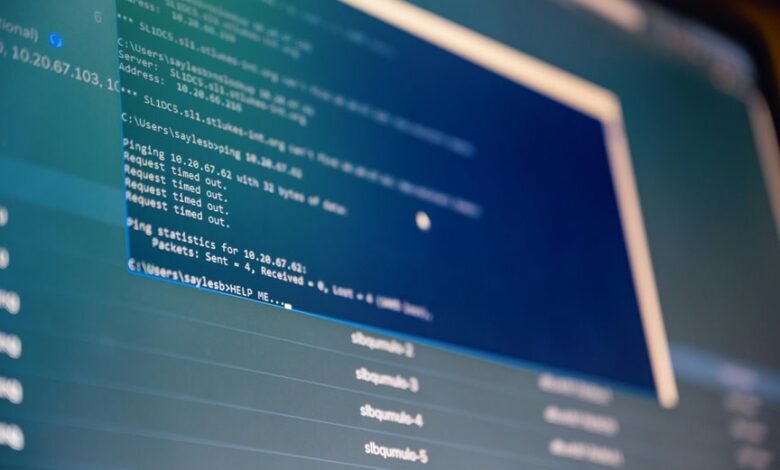
Web & System Analysis treats each telemetry identifier as a data point in a broader performance map. The approach traces signals from user-facing flows to underlying bottlenecks, separating noise from meaningful patterns. It emphasizes profiling CPU, memory, and I/O, then translating findings into targeted architectural changes. Governance, privacy, and auditable controls frame decisions, with feature flags guiding iterative improvements. The path forward is data-driven and systematic, but the next move hinges on how well signals align with real user journeys.
What the Numbers and Names Reveal About Web Performance Signals
Web performance signals are quantified through a suite of metrics and names that together describe the user-perceived and system-level behavior of websites.
The analysis dissects latency taxonomy, cache topology, and load shedding as structural drivers, revealing how timing, storage hierarchy, and failure tolerance shape experience.
This methodical framing supports freedom-oriented optimization, emphasizing transparent, data-driven decision making and measurable improvements.
Tracing System Behavior: From Telemetry to Actionable Bottlenecks
Tracing system behavior begins with converting collected telemetry into actionable signals. The approach maps site telemetry to concrete bottleneck indicators, separating noise from signal through structured filtering and baselining. Bottleneck mapping quantifies hotspots, while user latency profiles timing variance across cohorts. Resource profiling aligns CPU, memory, and I/O burdens with observed behavior, enabling targeted, auditable remediation decisions.
Data-Driven Decisioning: Aligning Architecture With Real User Flows
Data-driven decisioning maps real user flows to architectural choices, ensuring system design directly supports observed usage patterns. Analytical assessment links telemetry to structure, governance, and agility. Data governance informs data models and access, while feature flags enable iterative rollouts without architecture overhaul. Clear governance, disciplined experimentation, and modular components align platforms with evolving user paths, preserving freedom through transparent, data-backed decisions.
Security, Privacy, and Efficiency: Balancing Risk and Performance
Security, privacy, and efficiency form a triad that must be balanced through measurable criteria and iterative evaluation. The analysis identifies security tradeoffs and efficiency metrics, evaluating impact on user autonomy and system resilience.
Privacy preserving approaches are benchmarked against performance costs, revealing scalable strategies. Decisions emphasize data minimization, transparent logging, and auditable controls, ensuring freedom while sustaining robust, repeatable security and operational effectiveness.
Frequently Asked Questions
How Do You Measure User-Perceived Performance Milestones?
Perceived latency can be measured through time-to-interaction and task completion metrics, correlating with user satisfaction via surveys and NPS. Data-driven dashboards analyze thresholds, variance, and comfort zones, enabling iterative improvements while preserving user autonomy and freedom of choice.
Can You Quantify the Cost of Telemetry on UX Latency?
Latency budgeting and telemetry cost can be quantified by modeling added UX latency per telemetry event, aggregating across users, and comparing against revenue impact; a structured, data-driven approach yields actionable telemetry cost estimates and optimization opportunities.
What Governance Ensures Data Retention Doesn’t Degrade Speed?
A governance framework and retention strategy establish a data retention policy to minimize speed impact; methodical analysis quantifies latency trade-offs, ensuring data retention practices align with performance targets, while preserving freedom to innovate and adapt data flows.
Do You Differentiate Synthetic vs. Real-User Traffic Impact?
Traffic impact differs: synthetic traffic can be modeled and stress-tested, while real user patterns reveal authentic latency and engagement. The analysis compares both, isolating bottlenecks, ensuring governance avoids bias, and preserves performance for real user experiences.
How Is Anomaly Detection Tuned for Evolving Workloads?
Anomaly tuning adapts to evolving workloads by continually measuring baseline drift, recalibrating thresholds, and validating with labeled incidents; workloads drift are monitored to adjust sensitivity, ensuring false positives remain controlled while capturing meaningful deviations in real time.
Conclusion
In a disciplined, data-driven cadence, the telemetry speaks in measured codes and quiet signals. From numeric fingerprints to user-named identifiers, the traces reveal bottlenecks with clinical clarity, enabling targeted orchestration of CPU, memory, and I/O. The approach translates chaos into auditable decisions, aligning architecture with real user flows while honoring privacy and governance. Like a lighthouse in a fog of data, the analysis guides steady optimization, balancing speed, security, and freedom in a resilient performance ecosystem.